Black mould testing in Toronto and York Region
When people say black mould, they often mean Stachybotrys chartarum — the species that grows on wet drywall, wallpaper, carpet, and wood after a leak. Studies have linked black mould to memory problems and lung irritation. It likes to hide: behind a wall, above a ceiling tile, under a carpet pad. You may only notice a stain, a musty smell, or someone in the house — or at work — who cannot stop coughing.
Dark growth on a surface is not a diagnosis. Aspergillus, Alternaria, Cladosporium and other indoor moulds can look black too. MouldChek Environmental is a woman-owned laboratory. We inspect, we take the sample, and our microbiologists identify what is actually growing. We will not remediate it. That would be a conflict of interest. The report names the species and, for air samples, the count against an outdoor reference. Then you decide what to do — or we consult on someone else's cleanup.
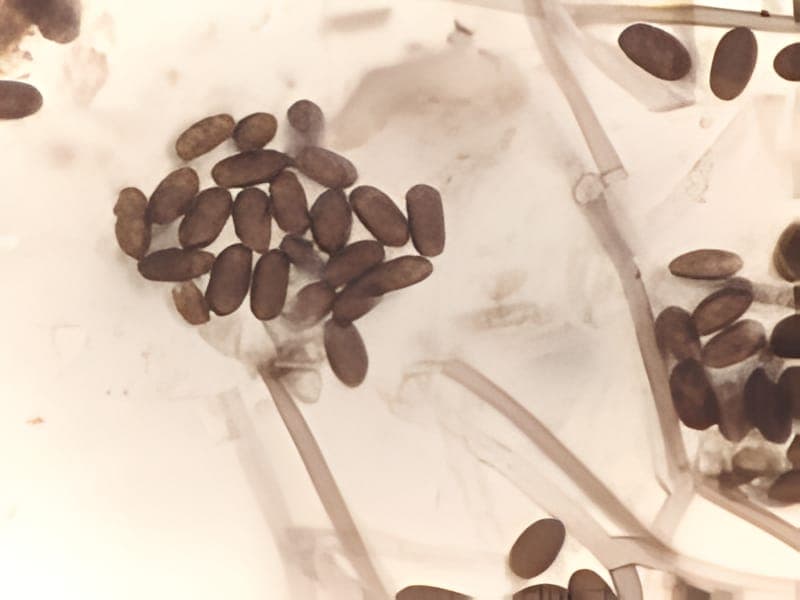
Stachybotrys chartarum (the black mould) is found on water-damaged buildings, insulator foams, wallpaper, carpets, basement drywall, wood, and indoor air. For some toxic moulds, even a very low spore count indoors is a reason to look further. We always take an outdoor air sample on the same visit so the indoor count has something to be compared with. The full species list is on Immediate Attention Moulds.
How we test for black mould
Where you can see growth, a tape-lift or bulk sample is the honest first step — a piece of drywall, a scrap of wallpaper, a press of clear tape. Where you cannot see it, or the complaint is the air itself, we use spore-trap cassettes (Air-O-Cell and Micro5) as part of an indoor air quality assessment.
Seniors, babies, mothers-to-be, small children, and anyone with an asthma-like history belong in the high-risk group. If the house had a leak, start with testing after water damage. If you are buying the house, see mould inspection before you buy. Cost and turnaround are quoted before we book — call 905-717-2713.
The same visit works in a workplace: a stained office ceiling or a wet industrial slab. Those jobs sit on commercial inspections. We inspect homes and commercial buildings in Toronto, Richmond Hill, Markham, Vaughan and the rest of York Region. Contact us if you suspect black mold and want it identified, not sold a cleanup.
Questions we hear
Is black mould always Stachybotrys?
No. Many moulds look dark on drywall or wood. Stachybotrys chartarum is one black mould that warrants prompt inspection, but Aspergillus, Alternaria, Cladosporium and others can also stain a surface. A laboratory identification tells you what is actually growing.
Can you test for black mould if I cannot see it?
Yes. Black mould often hides behind walls, under carpet, or above ceiling tiles after a small leak. We take tape-lift or bulk samples where growth is visible, and air samples (with an outdoor reference) when the concern is a smell, a stain we cannot reach, or a health complaint.
Does a low Stachybotrys count still matter?
For some toxic moulds, including Stachybotrys, even a very low indoor count is a signal for further evaluation. Indoor levels should generally be similar to or lower than the outdoor sample we take on the same visit.
Will MouldChek remove the black mould?
No. We inspect, sample, and identify. We will not remediate — that would be a conflict of interest. Once you have the report, we can consult on the remediation done by others.
Do you test black mould in offices and industrial buildings?
Yes. Dark growth on a workplace ceiling tile or in a mechanical room is the same problem as a house — we sample it and name it. Offices, industrial buildings, and other commercial sites are regular work.